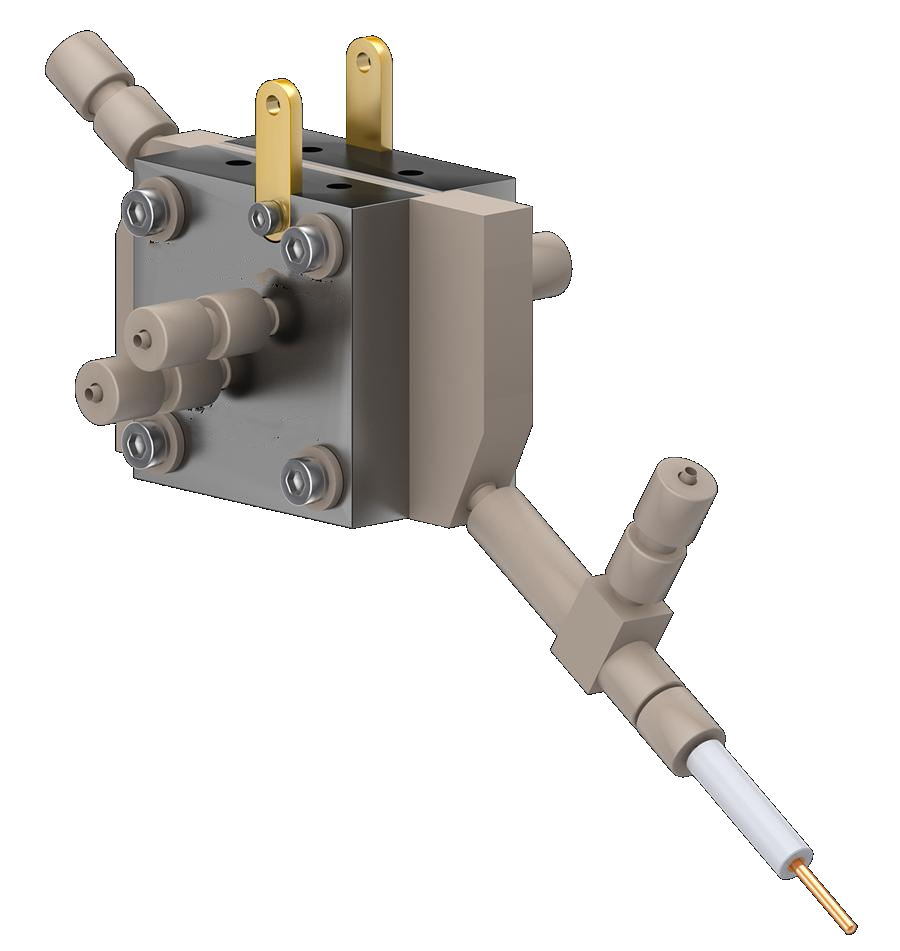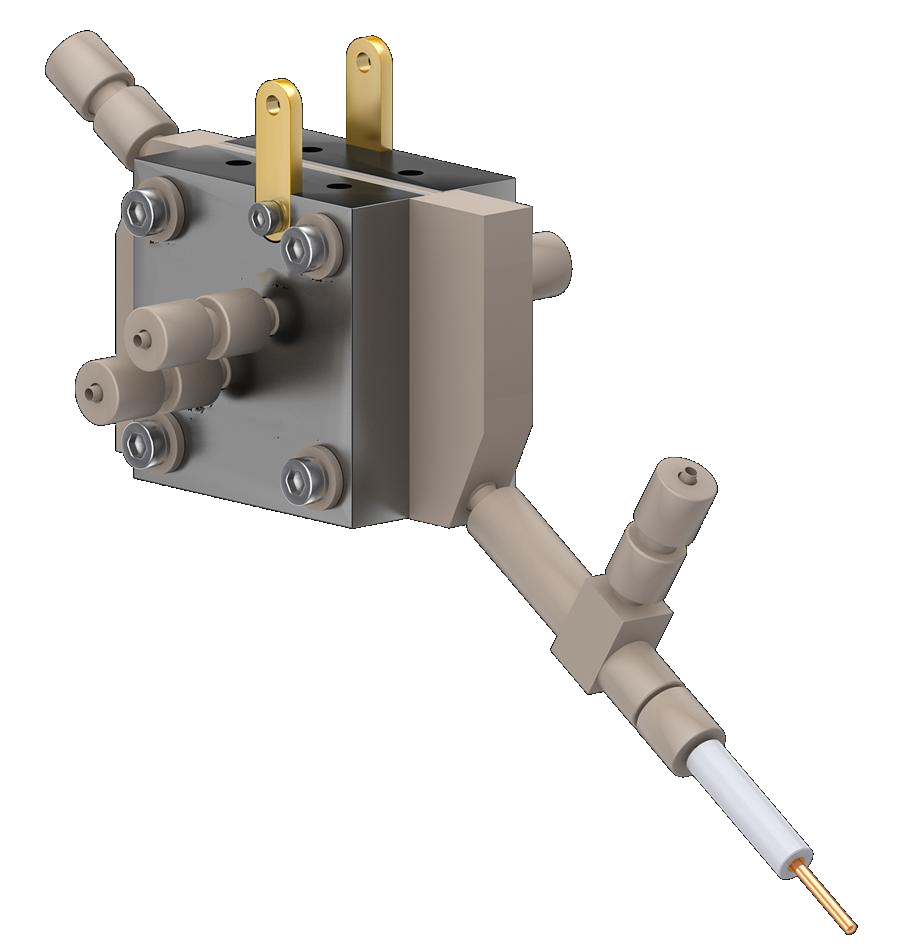
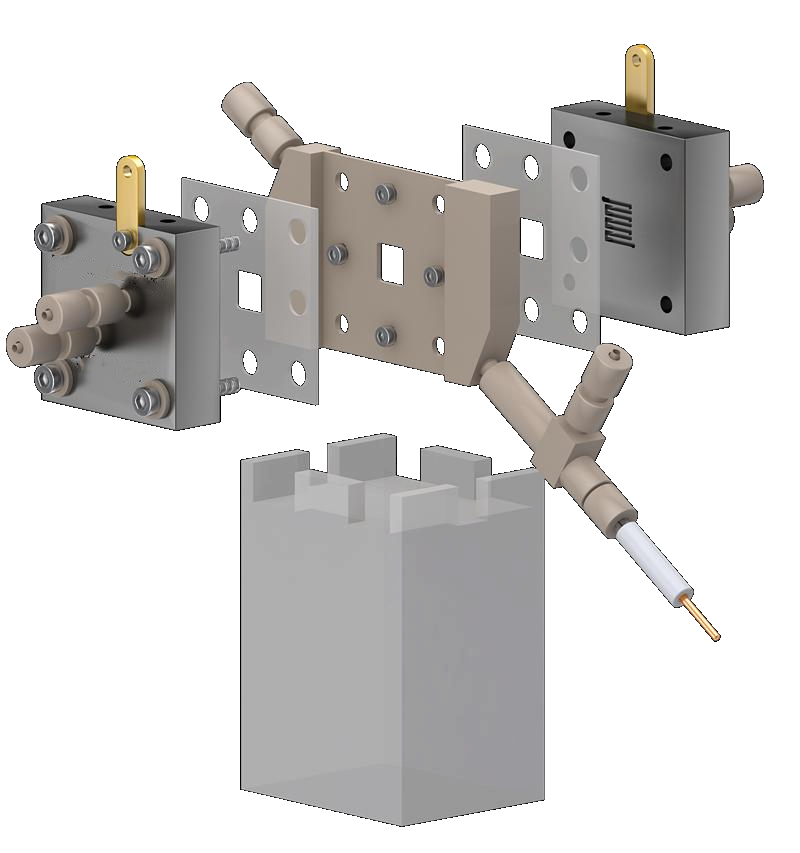
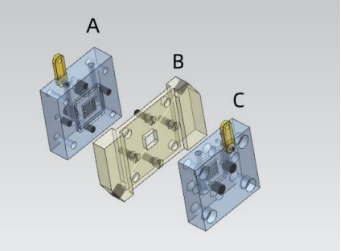
The reaction cell adopts sandwich structure and can be freely combined into CO2 reduction gas diffusion according to experimental requirements
Electrolytic cells, solid state electrolytic cells for the production of pure liquid products, and membrane electrode reactors.
• Reaction chamber size: 10*10mm
• Reactor material: high purity titanium +PEEK
• Reaction area: 1 cm2
•peek chamber thickness: 1.2mm
• Standard reference: Agcl electrode
Membrane Electrode-Gas Diffusion Multifunctional Electrolytic Cell Using Methods and Skills
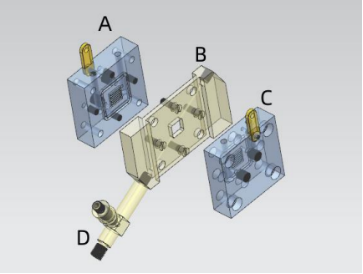
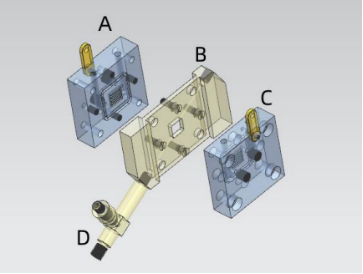
As shown in the above figure, the electrolytic cell adopts a sandwich structure and is divided into four parts: A, B, C, and D.
Ø Parts A and C have serpentine channels and are made of high-purity titanium. Part C can also be replaced with high-purity nickel.
Ø The B cavity is I-shaped as a whole, and the thickness of the middle part is 1.2 mm. Using the B cavity, the distance between the cathode and anode (A and C) can be controlled within 1.6 mm.
Ø Part D is the plumbing fitting for the reference electrode.
Function 1: CO2 reducing gas diffusion electrolytic cell (as shown in the above figure).
- Plate A is used as a chamber for humid CO2gas to pass through, a gas diffusion electrode (carbon paper) is placed between A and B, and plate B is used as a cathode liquid flow chamber.
- Anion exchange membrane and anode are placed between B and C. The anode can be a metal mesh loaded with a water-splitting catalyst, or a metal foam with water-splitting activity.
- Part C circulates neutral or alkaline electrolyte for water oxidation reaction.
- Part D places the reference electrode and also serves as the cathodic chamber liquid in and out. The reference electrode is inserted upside down at 45 degrees, which can quickly eliminate the interference of air bubbles.
Gas diffusion electrolytic cell usage skills:
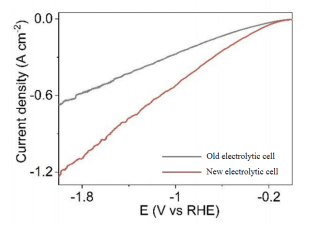
- Cathode:SGL-22BB is the best (small overpotential at the same current density).
- Anode:Titanium-plated iridium oxide is preferred, and nickel foam is also acceptable, but the overpotential of foamed nickel at high current density is higher than that of titanium-plated iridium oxide. The stability of nickel foam at medium current density (<300 mA cm-2) is better than that of titanium plated with iridium oxide, which may be related to the better gas transport of nickel foam.
- Ionic membrane:Fumasep FAB-PK-75 is preferred for alkaline conditions (FAB-PK-150 is not recommended, the impedance is too large, which affects the current density; FAB-PK-50 and FAB-PK-75 have similar performance, but the constant current test the potential of FAB-PK-50 is not stable under the condition).
- Assembly:assembly is very critical and directly affects the performance of the electrolytic cell; it is recommended to use a torque wrench, the recommended torque is 4-6 NM, tighten gradually in 2-3 times, and the torque must be uniform. Excessive torque has the potential to puncture the membrane or shatter the electrodes.
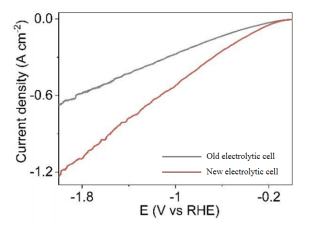
Test instance:
Function 2: Solid-state electrolytic cell for producing pure liquid products (as shown in the following figure).
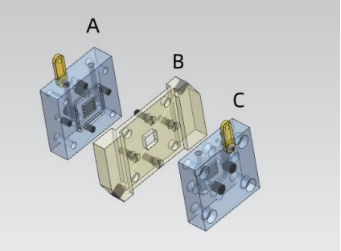
Combine the three parts of ABC and remove part D, use the solid electrolyte based on ion exchange resin to replace the liquid electrolyte, avoid the introduction of ions, and directly realize the preparation of high-purity liquid products (in theory).
The specific structure is as follows:
- Parts A and C have serpentine channels to prolong the residence time of the gas and improve the gas conversion rate.
- Plate A is used as a chamber for humid CO2gas to enter, and a gas diffusion electrode (carbon paper) and anion exchange membrane are placed between A and B (to ensure sufficient contact, cold pressing or hot pressing process can be used).
- A cation exchange membrane and anode are placed between B and C. The anode can be a metal mesh loaded with a water-splitting catalyst, or a metal foam with water-splitting activity. Part C is passed through the acidic electrolyte to carry out the water oxidation reaction.
- Part B is the core component of the solid-state electrolytic cell. The cavity is I-shaped as a whole, and the thickness of the middle part is 1.2 mm. The middle part has a 1×1 cm square through hole. The through holes can be filled with granular ion exchange resin as a solid electrolyte to replace the liquid electrolyte to realize the direct preparation of pure liquid fuel. By passing pure water into part B, the liquid product can be taken out of the reactor to obtain a pure liquid phase product aqueous solution free of anions and cations.
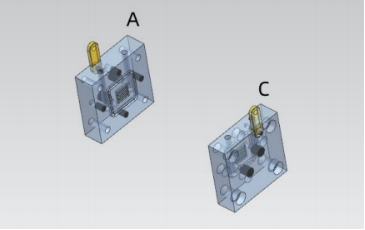
Function 3: CO2 reduction membrane electrode electrolytic cell (as shown in the following figure).
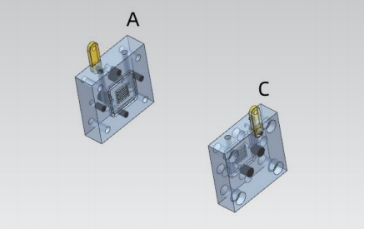
Combine parts A and C, remove parts B and D, and construct a membrane electrode electrolytic cell.
The specific structure is as follows:
- Parts A and C have serpentine channels to prolong the residence time of the gas and improve the gas conversion rate.
- Plate A acts as a chamber for humidified CO2gas, between A and C in sequence (from A to Corder) place the gas diffusion electrode (carbon paper), anion exchange membrane or proton exchange membrane (to ensure full contact between gas diffusion electrode and ion exchange membrane, can use cold pressing or hot pressing process) and load Metal mesh with water-splitting catalyst (also metal foam with water-splitting activity).
- Part C is passed through neutral or alkaline electrolyte for water oxidation reaction.